
Reading Is Not Enough To Make You Wise
 admin
Sep 4, 2026
95
0
admin
Sep 4, 2026
95
0
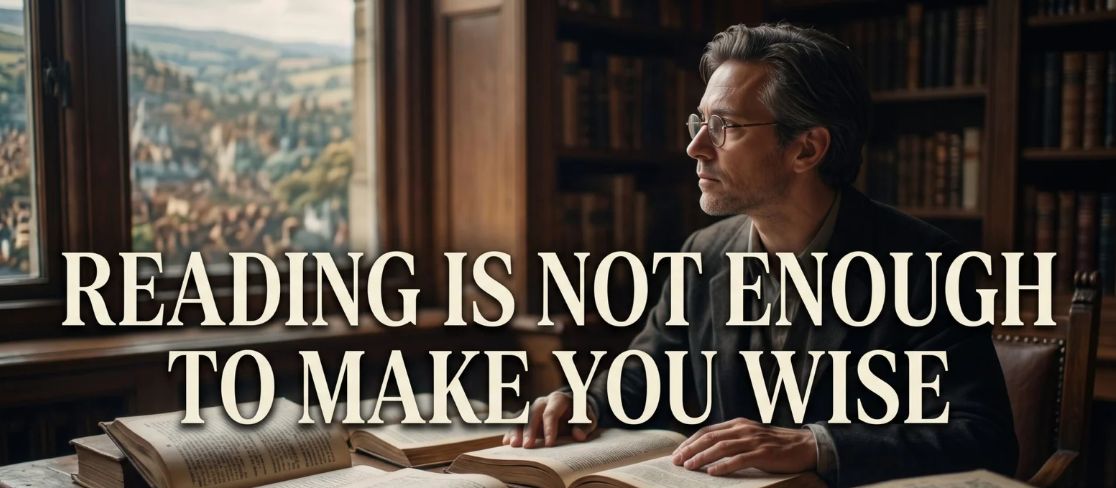
Reading changed my life.
I cannot imagine my life today without the influence of the things I’ve read.
Books introduced me to ideas I would never have encountered otherwise. They gave me language for thoughts I couldn’t articulate and forced me to examine parts of life I had ignored.
Some changed how I think about money. Others changed how I understand people. A few changed decisions I was already making.
But that experience can create a false assumption: that reading itself guarantees intellectual growth.
If reading makes us smarter, why can someone read hundreds of books and still think exactly the same way?
We can read for years and still make the same judgements, defend the same assumptions, and ask the same questions.
You can read about human behaviour and still misread the people closest to you. You can study how incentives shape decisions and still assume that people who disagree with you are simply irrational. You can read about failure and still protect the story you tell yourself about your own.
We can even read people who disagree with us and finish the book more convinced that we were right.
A book can change what we know without changing how we think.
Worse, reading can sometimes make us better at defending the person we already are.
The question, then, isn’t simply how much we read.
It’s what reading does to the way we think.
We Don’t Read With Empty Minds
Nobody comes to a book empty.
We bring our history: our fears, ambitions, loyalties, definitions of success, and assumptions about how people and the world work.
When an author gives us an idea that fits our worldview, we nod. When they give us an idea that threatens it, we start arguing.
We think:
“That doesn’t apply to me.”
“The author doesn’t understand my situation.”
“That’s unrealistic.”
Some objections are justified. Others protect assumptions we have never examined.
That’s why two intelligent people can read the same book and reach different conclusions.
The book didn’t change. The readers did. They brought different assumptions to it.
Francis Bacon captured this distinction centuries ago in Of Studies:
“Read not to contradict and confute; nor to believe and take for granted; nor to find talk and discourse; but to weigh and consider.”
Bacon asks us to weigh ideas carefully before deciding what to believe.
We don’t have to agree with an author. We have to be willing to discover that our explanation is incomplete.
That’s where genuine thinking begins.
But our own assumptions aren’t the only thing working against us. The information environment surrounding us can make those assumptions feel even more certain.
The Internet Has Made Familiar Ideas Feel New
The internet has made it easier than ever to surround ourselves with ideas we already agree with.
Search for an argument about remote work and soon you’re shown more arguments about remote work. Spend an afternoon watching videos about investing, and the next day your feed is full of people explaining how to build wealth. Follow people who share your worldview long enough, and eventually disagreement becomes harder to encounter by accident.
The result is a strange kind of intellectual comfort. We feel informed because we’re constantly consuming ideas, even when most of those ideas are variations of arguments we’ve already accepted.
We can hear the same idea from ten different people and start believing it simply because we keep hearing it. Familiarity starts feeling like proof that we’re right. Ten people repeating the same argument don’t make it any more true.
Books can create the same illusion.
Someone can read twenty books about productivity, personal finance or relationships and feel like they’ve explored a wide range of ideas. The authors change. The stories change. The language changes. The underlying assumptions can remain untouched.
That’s how reading can give us more information without giving us a wider view of the world.
At some point, we have to become curious about the ideas we’re not encountering.
That means reading against ourselves.
If you believe remote work is the future, read someone who thinks it is damaging company culture. If you believe ambition is essential, read someone who thinks ambition can become a trap. If you believe people succeed mainly through hard work, read someone who can make that explanation harder to accept.
Don’t look for the easiest argument to defeat. Find the strongest argument that could actually change your mind.
The goal is to discover where our own explanations are incomplete, even when that means taking an opposing idea seriously.
We can become extremely well-informed and still never seriously question the ideas that shaped us.
Intelligence Can Help Us Defend What We Already Believe
A capable mind can become remarkably good at defending a conclusion it reached before asking whether it was right.
Give someone enough information and they can build an impressive case for something they already believe.
They can search for evidence that supports their view, remember the examples that make their position look strongest, and dismiss the ones that complicate it. A person can turn a preference into a principle, a fear into a philosophy, and a personal failure into a theory about how the world works.
Reading gives us even more material to build those arguments.
Consider someone who reads five books about relationships and becomes convinced they understand attachment, communication and human behaviour.
Then their partner tells them they’re emotionally unavailable.
Instead of considering the criticism, they reach for everything they’ve learned. They diagnose their partner’s behaviour. They explain their partner’s motives. They find a psychological concept that makes their own behaviour look reasonable.
Sometimes the more we know, the better we become at defending what we already believe.
This happens in everyday life.
A person learns about boundaries and starts using the language of boundaries to avoid accountability. Someone learns about narcissism and begins diagnosing everyone who frustrates them. Someone studies productivity and becomes better at explaining why they’re busy than at asking whether their work matters.
Knowledge can give us more ways to justify what we already believe.
That’s why accumulating knowledge isn’t enough.
More information does not guarantee better judgement.
We should pay attention when almost everything we read seems to confirm what we already believe.
Some beliefs deserve to become stronger when exposed to better evidence. Others deserve to be revised.
If your reading almost never changes your mind, you’re missing one of the most valuable things reading can do.
John Stuart Mill wrote in On Liberty
: “He who knows only his own side of the case, knows little of that.”
Knowing what you believe is easy. Knowing why you believe it is much harder.
If you’ve never seriously considered the strongest argument against your belief, you may know what you believe without fully knowing why you believe it.
When you encounter an unfamiliar argument, ask: “How do I know this is wrong?”
Then ask the harder question: “What would I have to believe for this person to be right?”
You can examine an opposing argument seriously without adopting it. You can look for the strongest version of an idea rather than the easiest version to dismiss.
That’s harder reading, and it’s usually more valuable.
The Best Books Will Irritate You
The books that change your thinking aren’t necessarily the books you enjoy most. Sometimes they’re the ones that make you want to argue with the author.
They expose an assumption you didn’t know you had, challenge a belief that has become part of your identity, and make an unfamiliar possibility difficult to ignore.
Just because a book is irritating doesn’t make it right. Sometimes irritation is the correct response to a bad argument.
When an idea bothers you deeply, ask what exactly is being threatened: your belief or your identity.
Suppose someone challenges a belief you’ve held for years. Your first instinct is to defend it.
Instead, test another possibility: Suppose they’re partly right.
What would that change?
That shift turns reading into a test of your thinking.
You stop asking whether the author is someone you agree with and start asking whether their argument exposes something your current view cannot explain.
It also changes how you choose books.
If every book on our shelf makes us feel understood, informed and validated, we need a different shelf.
Read the strongest argument against a belief you hold. Seek out the intelligent critic rather than the obvious fool. Find someone who sees the world from a position you have never seriously considered.
Choose ideas that challenge your reasoning, not books that confirm your identity.
Try this the next time a book makes you angry.
Don’t immediately underline the sentence you disagree with.
Write down why you disagree. Then write the strongest argument the author could make against your position.
Finally, ask yourself one question: “What evidence would actually change my mind?”
If the honest answer is nothing, you’re no longer evaluating an idea. You’re protecting an identity.
Stop Measuring Reading by Pages
I’m not impressed by how many books someone says they’ve read. I care more about what those books changed in them.
Did a book make them reconsider a decision they had already justified? Did it change how they interpreted someone’s behavior? Did it make them admit they were wrong?
Those are better measures of reading.
A person who reads 100 books to confirm what they already believe may be less intellectually developed than someone who reads five books that force them to rethink themselves.
Our heads are already full. What matters is whether reading changes how we think.
So when you finish a book, don’t immediately ask, “What did I learn?”
Ask instead: “What did this book make harder for me to believe?”
If the answer is nothing, that’s fine.
But if the answer is never, something has gone wrong.
You can collect information without actually changing how you think.
The real test of reading is what happens to the ideas you already believe.
A good book should leave something behind that survives the final page: a changed assumption, a better question, a decision reconsidered, or an explanation that no longer feels complete.
That’s what makes reading matter.
Reading Should Change the Questions We Ask
Reading changed my life because I didn’t just collect ideas from books.
Some ideas changed the questions I asked. Some changed the decisions I made. Some expanded what I thought was possible. And a few changed what I thought I knew.
Reading should make us question the explanations we’ve always relied on.
Michel de Montaigne built much of his philosophy around a deceptively simple question: Que sais-je? — “What do I know?”
It’s a small question, but it cuts through the illusion of certainty.
There’s a difference between filling your head with information and changing how you think.
Information accumulates. Good reading changes how we make sense of it.
The best books leave us with better questions, harder problems and fewer easy explanations. They make it harder to see the world exactly as we did before.
That’s when reading becomes thought.
And that’s when thought can begin changing a life.
The goal is simple: To become a little harder to fool, including by ourselves.












Comments (0)
Facebook Comments (0)