
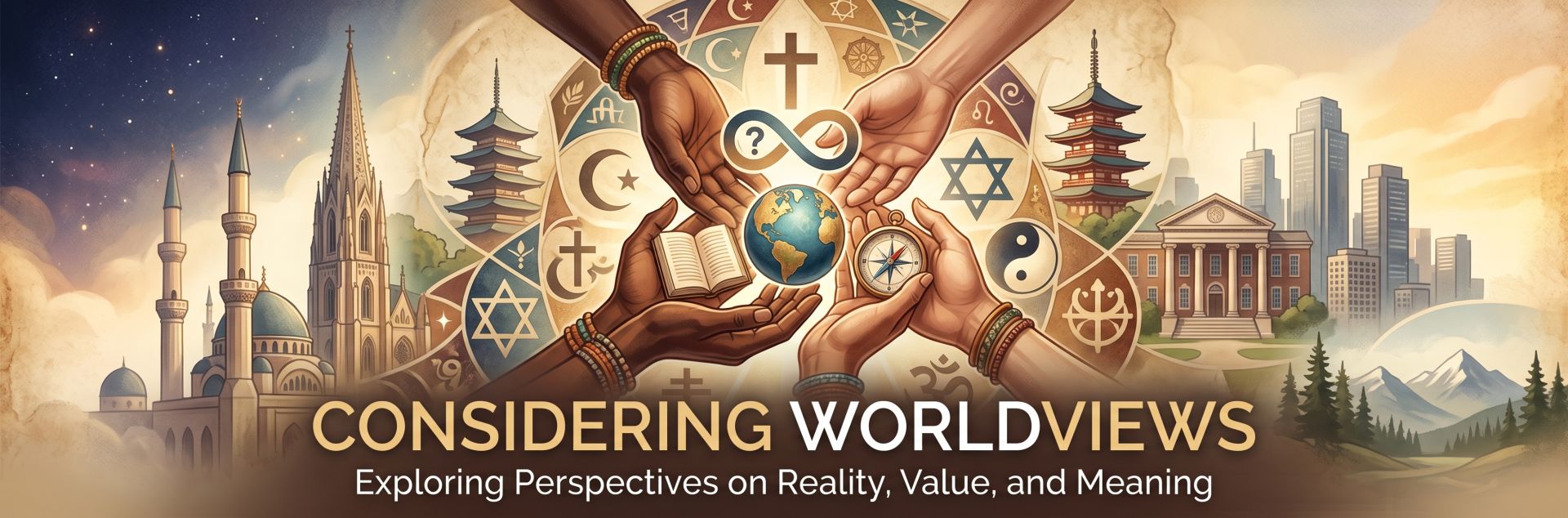
Considering Worldviews
 admin
Aug 23, 2026
150
0
admin
Aug 23, 2026
150
0
Someone recently left a comment on one of my articles explaining that there are two kinds of people in the world: thinkers and believers.
You will be shocked to learn that he considered himself one of the thinkers.
That is usually how these classifications work. The person drawing the line almost never discovers that they belong on the gullible, irrational or intellectually inferior side of it. Somehow, the categories always arrange themselves so that our own tribe represents reason, courage and independent thought, while everyone else is merely repeating what they were taught.
Here’s the comment, by the way:
Another reader then pushed the idea further, asking whether genes associated with low intelligence might make some people more likely to become fundamentalists.
Beneath both comments sits an increasingly common assumption: religious people believe because they are uneducated, unenlightened or incapable of thinking critically. Sceptics, meanwhile, have supposedly examined the evidence without bias and followed reason wherever it led.
Religious people can certainly be incurious, resistant to evidence and embarrassingly confident about things they do not understand. I spent enough years in church to know that firsthand. But none of those qualities is uniquely religious, and abandoning belief does not automatically turn someone into an independent thinker.
“Religious” is not a synonym for “unintelligent.” And skepticism is not proof that someone has learned to think.
The Myth of the Uneducated Believer
The obvious problem with this stereotype is that religious belief is not an intellectual category.
The word religious describes billions of people across countless cultures, traditions and ways of understanding the world. It includes fundamentalists who insist every word of the Bible must be read literally, but it also includes philosophers who have spent decades wrestling with questions of existence, consciousness and meaning. It includes people who have never seriously questioned what they were taught, alongside people whose faith has survived years of doubt, study and scrutiny.
Placing all of them on one side of a line marked “believers” and everyone else on the side marked “thinkers” tells us almost nothing about them. It simply allows the person drawing the line to feel intellectually superior.
Of course, intelligent people can hold bad ideas. Education does not make anyone immune to bias, wishful thinking or tribal loyalty. Highly intelligent people are often exceptionally skilled at finding sophisticated reasons to defend what they already want to believe.
But that cuts both ways.
A person does not become a careful thinker merely by rejecting religion. Scepticism can be thoughtful and well-informed, but it can also be shallow, inherited and remarkably incurious. Someone who dismisses every religious person as brainwashed has not necessarily examined religion more carefully than the fundamentalist who dismisses every atheist as rebellious. They may simply have learned a different set of answers from a different tribe.
There are serious arguments against belief in God, just as there are serious arguments for it. Those arguments deserve to be considered on their merits. But saying that people believe because they are stupid is not an argument. It is a way of avoiding one.
You do not demonstrate your intelligence by declaring everyone who disagrees with you unintelligent.
In fact, when you do, you only make yourself look suspiciously like the the people you are trying to discredit.
What Has Your Worldview Made of You?
I respect anyone who has done the work of wrestling with their beliefs.
I respect the atheist who has wrestled honestly with the evidence and concluded that belief in God is no longer possible. I respect the believer who has faced the hardest questions, resisted easy answers and still finds faith compelling. I even admire a certain confidence in both — the courage to plant your feet somewhere and say, “This is what I believe.”
What I struggle to respect is arrogance.
Arrogance is not evidence that you have thought more deeply than everyone else. Often, it is evidence that your worldview has become another way to feel superior. Religious people do this when they treat unbelievers as morally corrupt or spiritually blind. Sceptics do it when they treat believers as intellectually deficient people who have not yet caught up with the enlightened.
If your beliefs consistently make you less curious, less compassionate and more dismissive of other people, I am not particularly impressed by how certain you are that they are correct. Whatever else your worldview may have given you, it does not appear to be helping you become a better human being.
Behind this kind of arrogance sits another assumption: if religious people knew what the enlightened know, they would stop believing.
Another reader made that assumption explicit. After explaining that the Bible was written by people with less knowledge than we possess today, he told me I had failed to take “the next obvious step” and recognise that God was made up too. He then encouraged me to face death with enough “bravery and grace” not to need a magical afterlife.
Notice what is happening there. Disbelief is not being presented as one possible conclusion after examining the evidence. It is the obvious next step. Anyone who stops short of it must be trapped in cognitive dissonance, frightened of death or unable to live morally without divine supervision.
It leaves no room for the possibility that someone might know how the Bible was written, understand its historical context, accept modern science, recognise the psychological functions of religion and still believe in God. The believer cannot have considered the evidence and interpreted it differently. They must simply lack the courage or clarity to follow it to its supposedly inevitable conclusion.
Source:
Why Young Women Are Leaving the Church in Droves
????
Others will examine the same questions and lose their faith entirely. I respect that conclusion. What I do not accept is the assumption that one person has considered the evidence while the other has merely failed to understand it.
“I no longer believe” is an honest conclusion.
“Anyone who still believes must not know what I know” is just intellectual arrogance.
What About People Who Haven’t Done the Work?
There is one more thing worth saying.
Not everyone has spent years studying philosophy, theology, biblical history or evolutionary psychology. Most people are busy working, raising children, caring for family members and trying to keep their lives together. They inherit a way of seeing the world and, for the most part, get on with living in it.
Some inherit religious belief. Others inherit scepticism. Neither group necessarily arrives there after an exhaustive investigation of every alternative.
That does not make them stupid, and it certainly does not make them less worthy of respect.
We have developed a strange habit of treating intellectual sophistication as though it were a measure of human value. The person who can explain their worldview using the right language is taken more seriously than the person who cannot. Yet being well-read does not necessarily make someone wise, kind or good. Sometimes it simply gives them more impressive ways to look down on people.
You can disagree with someone’s beliefs without treating them as an inferior kind of person. You can challenge an argument without mocking the mind of the person making it. You can even believe someone is profoundly wrong while recognising that they remain as human as you are.
That should not be a particularly radical idea. But apparently, it still needs to be said.
We Could All Stand to Be a Little More Humble
I am not asking anyone to pretend that all beliefs are equally reasonable. Religious ideas should be questioned, challenged and, when necessary, rejected. I have spent much of my writing life doing exactly that.
Nor am I suggesting that sceptics should secretly become believers. If you have examined the question and concluded that there is no God, I can respect that. The question is whether you can respect someone who has done the same work and reached a different conclusion.
You may think I am wrong. You may even think my reasons for believing are inadequate. But that is different from assuming I believe because I am uneducated, frightened or incapable of following the evidence to its obvious conclusion.
Perhaps there are not two kinds of people after all: thinkers and believers.
Perhaps there are simply people trying to make sense of existence with limited knowledge, complicated histories and more biases than any of us can see clearly. Some of us believe in God. Some of us do not. Most of us are probably wrong about more than we realise.
That possibility should make us more curious about one another, not less.
At the very least, it should make us a little less smug.










Comments (0)
Facebook Comments (0)