
Elective Ignorance
 admin
Sep 5, 2026
124
0
admin
Sep 5, 2026
124
0
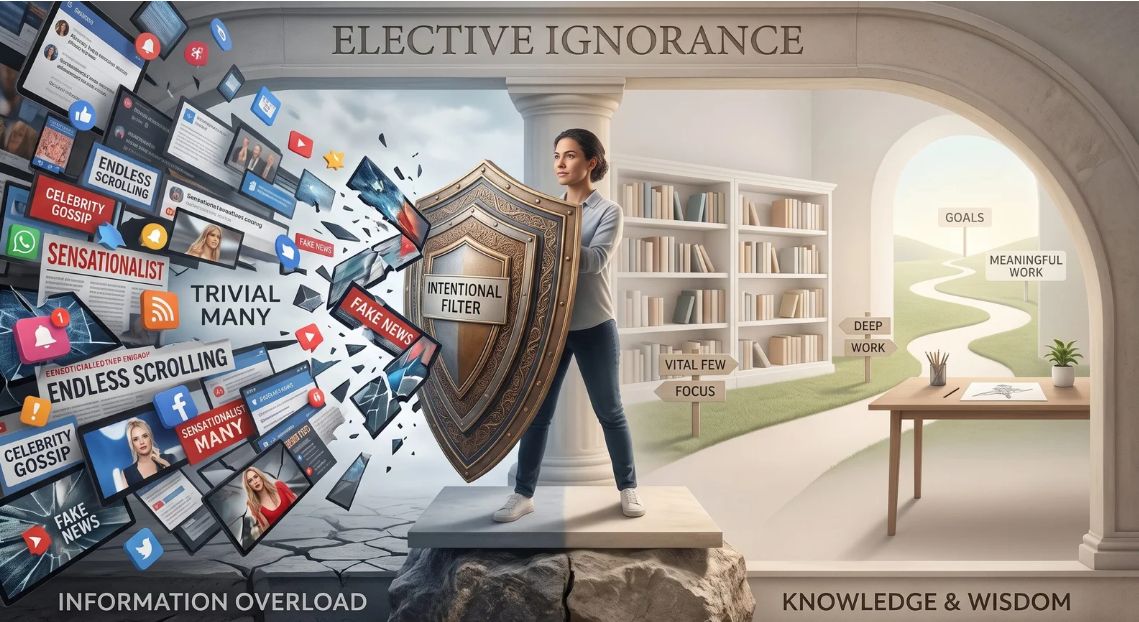
One word.
Elective ignorance.
Smart people deliberately choose the sources of their knowledge. It’s probably the greatest survival skill right now. If you find yourself with a double-edged sword, the best decision you can make is to know how to use it. The internet is the most powerful tool for learning, creating and doing amazing things. It “also turns us into lab rats constantly pressing levers to get tiny pellets of social or intellectual nourishment,” says Nicholas G. Carr. Right now, digital technology is too good to ignore by deliberate design. It’s chipping away at our ability to think and concentrate and making us impatient. The internet and the apps on your phone are harvesting your emotional data. To do this, they must make you feel. They demand emotional engagement. Be angry about this. React to this. Compare yourself to this. Laugh at that. Fear this right now. Purchase this immediately. Improve yourself immediately because an influencer in Dubai said your morning routine is weak.
You are the product.
Your attention is for sale.
Your emotions are the currency. The platform doesn’t care about your happiness or mental health. And the most reliable way to keep you engaged is to make you unstable. Digital technology has aged rather well to our detriment. Today, you can wake up, pick up your phone, and within five minutes you are told to be angry about a politician or worried about the economy. Oh, and be embarrassed by your body. Don’t forget to be jealous of someone’s holiday. And at the same time be impressed by the influencer’s wealth. Be frightened by that threat from the east too. Before you go, be ashamed that you haven’t started your “morning routine” at 4:30 a.m. Perhaps you need a supplement to fix your mornings. Or a course to become wealthy now.
And the strangest part?
You can spend the next hour reacting to all of it without realising that you were never required to react in the first place. It’s one of the most important things intelligent people understand about the internet. Not everything that gets your attention deserves your time or part of your life. And not everything that makes you feel something deserves a response. The race to predict our behaviour is at an all-time high. In 2019, Tristan Harris testified before the U.S. Senate. He had been a design ethicist at Google. Harris explained that the tech industry had inadvertently created a “race to the bottom of the brain stem".
The goal was to get the most attention.
He compared the interface of a smartphone to a slot machine.
Every time you check your phone, you pull the lever. You don’t know what you will get. A like? A nasty comment? A photo of a former classmate who is now a CEO? This changeable reward is addictive. It is the same mechanism that keeps a gambler at the table. Even smart people fall for this because they think they are immune. They read the articles. They go along with the algorithm. “When we pull our phone out of our pocket, we’re playing a slot machine to see what notifications we got,” says Harris. “The first principle is that you must not fool yourself — and you are the easiest person to fool.” Richard Feynman said that. He was a physicist, but he could have been describing a Twitter feed.
What do smart people know about the internet that you don’t?
Well, they know it’s a tool for alignment.
It aligns your behaviour with the goals of the algorithm. Those goals are not your goals. The algorithm wants you to stay on the screen. It does not want you to think. Deep thinking is slow. It doesn’t produce clicks. Shallow outrage produces clicks. Fear produces clicks. Envy gets clicks too.
You see a post about a twenty-year-old who built a million-dollar business. You immediately feel inadequate. But you are not sure why. You have a good life. But now you feel like you are doing life wrong. The algorithm was designed to make you feel like that. It has identified that your insecurity drives engagement. So it shows you more success. More beauty. More wealth. It builds a hall of mirrors where everyone is winning except you. The internet learns how to press your emotional buttons. Every time you open Instagram, TikTok, X, YouTube or Facebook, you are being invited into an emotional experience. Look at this. Admire this. Desire this. Be angry now. Compare yourself with this person. Argue with this stranger. Buy this even if you don’t need it. Improve yourself immediately.
It’s all designed for emotional engagement.
The goal is to get you to click, comment, share, watch another video, and check the replies. And return later to see what happened. The cycle continues. This dynamic is very powerful. The emotional information of your feed can influence the emotional mood inside your head. That should make you think. Your mood is one of the most valuable things you own. But people easily hand it over to an algorithm before breakfast.
Don’t confuse information and stimulation.
Of course, digital technology can pass on better knowledge. But it’s also designed for stimulation. The two can overlap. But they are not the same. A great article explaining inflation is information. A headline screaming that “the economy is collapsing” is stimulation. A biography of a successful creator can teach you something. “An influencer made $10 million in Dubai. You are still broke,” attacks your identity. You’re being invited to wonder. Why isn’t that me? Now you’re emotionally involved. And once you’re emotionally involved, you’re much easier to keep watching. The internet has turned comparison into an always-on activity. People have always compared themselves with others.
It’s nothing new.
What has changed is the scale.
On the internet, it’s not just your colleagues or friends. There are hundreds of thousands of lives to compare. Someone is fitter than you. Richer, younger. That man is travelling more. The influencer has a better house. That writer has written more books than you. They have more followers. Oh, and the productivity guru wakes up earlier than you. Someone has apparently achieved financial freedom at 23. And you are sitting there drinking coffee wondering what went wrong. This is absurd. You could be having a perfectly good Tuesday morning. Then you open your phone. Five minutes later, your life suddenly feels inadequate. Nothing changed about your life. Only the comparison changed. That’s the trick.
But intelligence can see through that.
You see the trap but still fall for it.
What should you do? Probably nothing. You don’t know this person. You don’t know their circumstances. Or whether the story is representative. A lot may have been omitted. And you certainly don’t know whether waking at 4:30 would improve your life. It doesn’t mean he’s lying. His life isn’t automatically evidence about yours. Intelligent people ask better questions. What did this person do? Under what circumstances? What facts support the claim? Can the result be replicated? What isn’t being shown? What is being sold? And the most important question is this.
Why is this showing up on my feed?
Follow the incentive.
What does this person, company or platform gain if I react?
If someone posts, “Nobody wants to work anymore.” Why is this in your feed? It may be an important social question. But it certainly looks like it’s looking for arguments. Someone comments. Someone disagrees. Another person gets angry. People share it. Another person writes a long response. Now the original post has generated hundreds of interactions. The platform wins. You might think you’re participating in an economic debate. The platform sees it as excellent engagement. Your emotional reaction is part of the business model. Think about what that means. You get angry at a post. You respond. People like the angry post. Your brain learns that anger gets rewarded. So you become a lot more likely to express anger next time.
If you keep reacting, you build an online personality around being outraged. And the algorithm keeps feeding your rage.
You are building a relationship with it.
You interact with content. The system observes. It learns. And shows you more. You interact again. The loop gets stronger. And even affects your real life or identity. If you spend three hours consuming outrage, your mindset will be different from someone who spends the same hours reading books, talking to friends, walking outside and working on personal projects. Same brain. Different inputs. You can stop reacting. This is an important skill for the modern mind. Learn to observe your emotional response before you act on it. “What is this feeling? Why am I being asked to feel it?”
The smartest people don’t let strangers’ opinions ruin their morning. They know that the algorithm rewards extremity. “This is a disaster” goes viral. So you must become a filter. You must actively curate your inputs. This is not about “digital detox” or “mindfulness” as a product you buy. I’m talking about ruthless selectivity. Unfollow the accounts that make you feel small. Block the topics that generate the most distractions. Use the mute button. It is the most powerful tool on your phone. I am not telling you to be ignorant. Just be more intentional. Read the primary source. Read the book. Read the long-form article. Don’t get dragged into that thread. The internet wants to save you time so you can spend more time on the internet. It wants to give you the “tl;dr” so you never have to think for yourself. “Seek not the favour of the multitude; it is seldom got by honest and lawful means.”
Plutarch said that.
You are smarter than the algorithm.
You have something it does not have. You have consciousness. You can close the tab. You can look away. Don’t let them steal your attention. It is the only thing you truly own. They are selling it back to you in pieces. A notification is a tiny theft. A push alert steals focus. So treat your phone like a sword. It can be useful. It can also be dangerous. The edge is your emotional response. That is where they make their money.
Do not bleed for free.
The internet makes things visible.
It doesn’t necessarily make them important. Virality is not proof of significance or truth. Controversy is not proof of importance. But your brain has a tendency to interpret repeated exposure as significance. If you see something ten times, it starts to feel familiar. If thousands of people are angry, you may begin to wonder whether you should be angry too. This is how your attention can be hijacked without anyone physically forcing you to do anything. Your phone can manufacture urgency. You need to know this now. This is happening right now. You must act before it’s too late. Everyone is talking about this. Your productivity is terrible. Your life needs fixing. There is always something.
But life is rarely like that.
Most important things are slow. Like friendships, learning, writing, building things, getting fit, building a better relationship with yourself and investing. Becoming good at anything is painfully slow. But the internet has difficulty selling slowness. So it sells urgency all the time. Stoic philosopher Epictetus had an internet problem before it existed. He argued that we should distinguish between what is within our control and what isn’t. You can’t control what the algorithm shows you. But you can decide whether to interact or respond to it.
Intelligent people build an emotional firewall.
Create a gap between seeing something and reacting to it. The internet wants immediate reactions. Intelligence requires delayed reactions. The feed wants you to react now. Wisdom says think first. Whatever you repeatedly pay attention to becomes part of your mental identity. If you spend too much time consuming productivity content, rest can begin to feel like a waste of time. That’s an expensive trade. The smartest thing you can do online is become harder to manipulate. Learn to recognise emotional hooks. Learn to tolerate boredom. These are surprisingly powerful skills. And they have nothing to do with having a high IQ. Use them as your intellectual self-defence.
The internet is not the enemy.
It’s one of the greatest tools humans have ever built. You can learn from the best people in the world from anywhere. Read books that would once have been impossible to find. Talk to people anywhere. Build, publish, find a job, create art, and share your work. And discover extraordinary ideas. The problem is forgetting it’s also a slot machine. It’s designed to keep you playing on loop. Your mind needs empty space. You need walks where nobody is talking to you. Meals without a screen. Conversations without notifications. Time when you’re not consuming anything. Boredom is good for your brain. Long stretches of uninterrupted thought are healthy. The internet gives you infinite stimulation. Fight back. Your brain needs space to process what you’ve already consumed. So protect that space.














Comments (0)
Facebook Comments (0)