
Giving To Be Seen?
 admin
Aug 26, 2026
92
0
admin
Aug 26, 2026
92
0
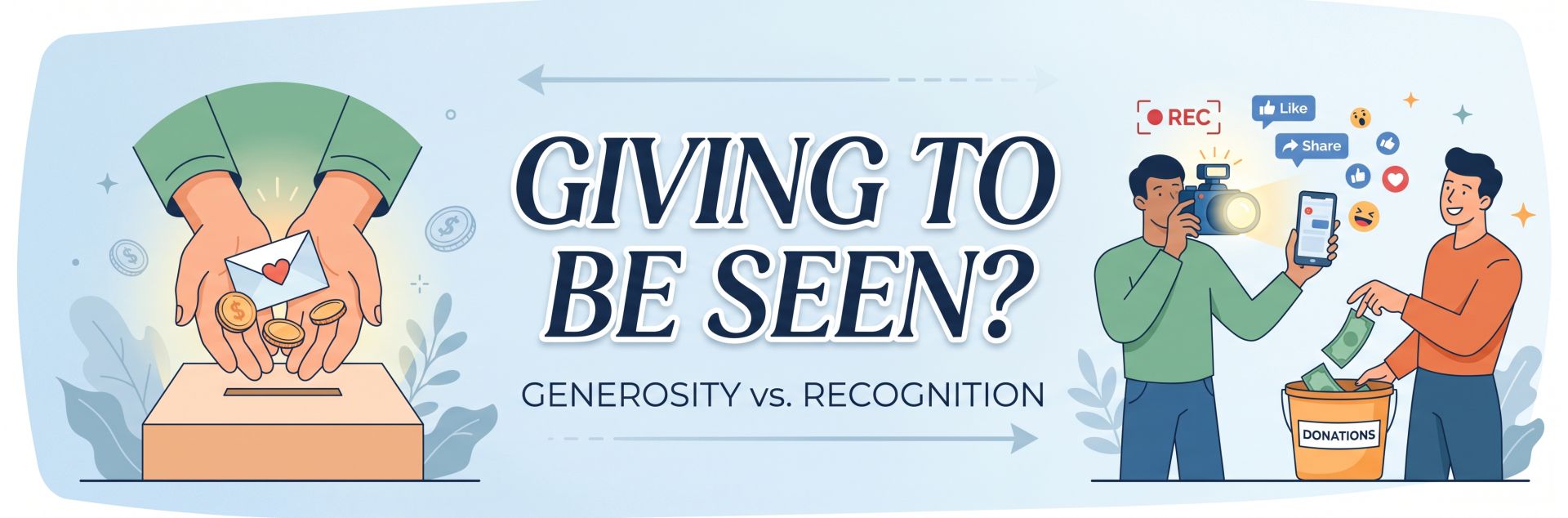
The Woman on Our Doorbell Camera Was Trying Not to Be Seen
Someone left dinner on our doorstep tonight.
We have absolutely no idea who it was.
There was no knock at the door. No text message telling us to check outside. No card tucked underneath the containers. No little note saying, “Thinking of you.” Just several containers of freshly cooked food sitting outside our front door.
And it was still warm.
Naturally, we checked the doorbell camera.
Sure enough, there she was. A woman walked up our driveway carrying the food, placed it carefully beside the door, turned around and left.
My wife and I watched the footage several times.
“Do you know her?”
“Nope. Do you?”
“No.”
We still have no idea who she is.
Someone, somewhere, knew enough about what our family is going through to decide we could probably use a meal. She bought the ingredients. She cooked the food. She packed it into containers. She drove to our house while it was still warm.
And then she left before we could even say thank you.
I don’t know why that part has affected me so much.
Perhaps it’s because there was no possibility of repayment. I couldn’t message her to tell her how much we appreciated it. I couldn’t thank her publicly. I couldn’t even give her the small reward of seeing our faces when we discovered what she’d done.
Whoever she was, she apparently didn’t need any of that.
She just wanted us to have dinner.
And then she disappeared.
Our mystery giver: Image from our doorbell cameraPress enter or click to view image in full size????
Would You Still Do It If Nobody Was Watching?
You’ve probably seen those videos on social media where someone approaches a homeless person and hands them $500, leaves an enormous tip for a waitress, pays for an elderly person’s groceries or surprises a struggling family with a car. I’ve watched plenty of them over the years, and I’ve always felt slightly conflicted about them.
Obviously, something good has happened. Someone who needed help received it, sometimes in a way that could genuinely change their circumstances. I’m hardly going to sit here complaining that a homeless guy was given $500 because the person handing it over happened to have an iPhone pointed at him. If the choice is between helping someone publicly and not helping them at all, I know which one I’d prefer.
Still, the camera complicates things.
The person receiving the gift is often being filmed at one of the most vulnerable moments of their life. Maybe they’re homeless, broke, grieving, exhausted or trying to work out how they’re going to feed their kids. Then a stranger arrives, does something incredibly generous and captures their reaction for the internet. Before long, their tears are in a thumbnail being watched by millions of people who know almost nothing about them beyond the fact that they needed help.
There’s an ugly but fairly accurate term for this kind of content: “generosity porn.” It describes generosity that has been turned into something for the rest of us to consume. We watch the surprise, wait for the tears, feel slightly better about humanity for thirty seconds and keep scrolling.
I should probably be careful here because I don’t think everyone who films themselves helping someone is secretly a narcissist. Sometimes those videos raise extraordinary amounts of money. Sometimes the income generated by the content funds the next act of generosity. Sometimes watching another person do something kind probably does inspire us to become a little more generous ourselves. Human motives are messy enough without me pretending I can diagnose someone from a sixty-second Instagram Reel.
But I do wonder whether something changes when being seen becomes part of the reward.
Maybe that’s why this anonymous meal has got me thinking about all of this. It wasn’t some enormous, life-changing act of generosity. It was dinner. But whoever brought it seemed perfectly content to receive nothing in return, including our gratitude.
And that has made me wonder about my own generosity. How much of what I give is really about the person receiving it, and how much do I enjoy the little reward that comes afterward? You know… the personal thank you, the heartfelt appreciation… having the other person think you’re such a good bloke.
I’m not sure I particularly like that question.
Jesus Understood the Currency of Being Seen
Jesus once described a kind of generosity that would be almost impossible to turn into an Instagram Reel.
“When you give to the needy,” he said, “do not let your left hand know what your right hand is doing, so that your giving may be in secret.”
The saying comes from the Sermon on the Mount, where Jesus is talking about something much bigger than generosity. He talks about giving, prayer and fasting, and each time he identifies the same temptation: taking something that is supposed to be directed towards God or another person and turning it into a performance for an audience.
What interests me is that Jesus doesn’t say the public acts are fake.
The money still gets given. The prayers still get prayed. The fasting still happens. His concern is that something else has been added to the transaction: the desire to be seen.
And then Jesus says something fascinating. People who do these things to be noticed have “received their reward in full.”
In other words, Jesus seems to understand that being seen doing good feels good. Recognition is a reward. Admiration is a reward. Having people think you are generous, spiritual or compassionate is a reward. Two thousand years before anyone could count likes, views or followers, Jesus understood that human beings could turn goodness into social currency.
His alternative is secrecy.
The left hand doesn’t need to know what the right hand is doing because nobody needs to be keeping score. The person in need receives what they need, while the giver relinquishes the opportunity to turn that need into something for themselves.
That changes the question from, “Did I do something generous?” to something much more uncomfortable.
“Who was this generosity actually for?”
I Think This Is What Jesus Was Talking About
The strange thing is that I might have witnessed exactly what Jesus was talking about tonight.
Whoever this woman is, nobody is going to applaud her for what she did. There will be no public acknowledgement, because we can’t give her one. Even writing this article feels slightly ridiculous because I’m telling thousands of people about an act of generosity while being completely unable to tell you who was generous.
Maybe she reads this blog. That thought has crossed my mind. Maybe someone who knows her will recognise the story and quietly pass it on. Or maybe she will remain completely unaware that I’ve spent my evening thinking and writing about something she probably considered a fairly ordinary thing to do.
I rather like the possibility that we never find out.
Because then the whole thing remains exactly what it was when she decided to do it: an act of kindness with no audience. We benefited from it, but she doesn’t get to benefit from our opinion of her. We can’t think more highly of her next time we see her. We can’t tell our friends what a wonderful person she is. We can’t even send a bloody thank-you text.
Whatever reward there is for doing something like that will have to come from somewhere else.
Jesus would say that part is between her and God.
And tonight, I think I understand a little better why he thought that mattered.
Now Do Something Nobody Will Know About
So here’s a challenge.
If you really want to do something generous, do something generous this week that nobody will ever know about.
I don’t mean giving anonymously and then telling your friends that you gave anonymously. Don’t post a cryptic Instagram story about how “it’s better to give than receive.” Don’t casually work it into conversation three weeks from now. Don’t even tell me about it in the comments.
Find someone who could use some help and help them.
Pay for something. Send something. Leave something at a door. Cover a bill. Put money somewhere it will be found. Find a way to make someone’s life slightly easier without leaving your fingerprints all over the good deed.
Then walk away.
You won’t get the thank you. You won’t see their reaction. Nobody will tell you what a wonderful person you are, and you won’t get the pleasure of watching the likes roll in.
That’s the point.
Because perhaps the real test of generosity isn’t how much we are willing to give.
It’s whether we are willing to give up the credit as well.













Comments (0)
Facebook Comments (0)