
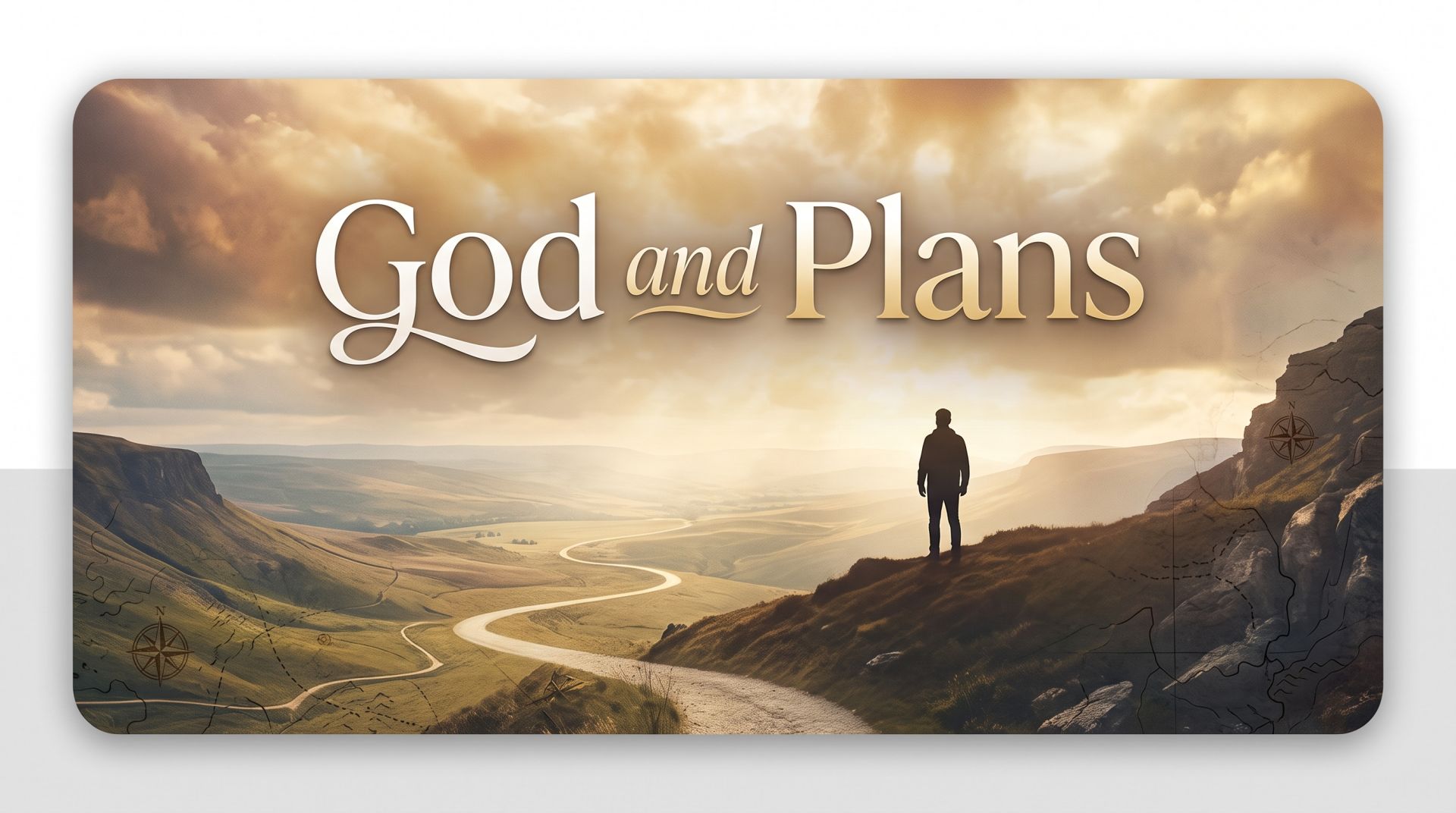
God and Plans
 admin
Aug 26, 2026
97
0
admin
Aug 26, 2026
97
0
Yesterday, I was the MC at a wedding.
I’ve MC’d enough weddings to know that the job is mostly about keeping things moving while giving everyone the impression that everything is completely under control. You have a run sheet. You know when dinner is being served, when speeches are happening, when the cake is being cut and when everyone is supposed to hit the dance floor.
And, if something goes wrong, you smile confidently into the microphone while quietly trying to work out what the hell you are going to do.
Yesterday, something went wrong.
Dinner was being served from two food stations, and my job was simple enough. When everything was ready, I would invite the tables up one at a time to collect their meals.
The caterers gave me the signal.
I picked up the microphone.
“Alright, Table One, you’re up.”
They stood, made their way towards the food and then stopped.
There were no plates.
Not not enough plates.
Literally, no plates.
As it turned out, the venue had assumed the external caterers would provide them. The caterers had assumed the venue would provide them. Presumably the bride and groom had assumed that when you paid people to provide a venue and food, somewhere in that arrangement plates would magically appear.
It was the perfect little storm of completely reasonable assumptions.
And now there were 120 hungry wedding guests, two stations full of food and absolutely nothing to eat it from unless they were happy to hold it in their own cupped hands.
Technically, this had nothing whatsoever to do with me.
I was the MC. My responsibilities did not include catering equipment, crockery or emergency plate procurement.
Unfortunately, I was also the bloke holding the microphone.
So my wife jumped in the car and raced to the nearest supermarket with instructions to buy every disposable plate she could find, while I did the only thing available to me.
I invented a game.
For the next little while, 120 hungry people played along with an impromptu piece of wedding entertainment that definitely wasn’t on the run sheet, while behind the scenes we waited for my wife to return with enough paper plates to save dinner.
Eventually, she did.
The food was served. The guests ate. The speeches happened. The wedding continued.
Just not according to plan.
And somewhere between desperately filling time with a microphone and watching 120 paper plates arrive through the door, I found myself thinking that this ridiculous little episode was a surprisingly accurate picture of life.
Because sometimes you can plan carefully, make sensible decisions, hire the right people and do everything you’re supposed to do.
And still, somehow, there are no plates.
The Trouble With the Plan
I suppose the obvious lesson from the great wedding plate disaster is that things don’t always go according to plan.
Hardly groundbreaking, I know.
But I’ve been thinking about why we’re so surprised when this happens. Because most of us know perfectly well that life is unpredictable, and yet we still seem to carry around a picture of how things are supposed to unfold.
I wonder if Christianity sometimes adds another layer to this.
Growing up in church, I heard a lot about God’s plan for my life. There was a person God wanted me to marry, a calling I needed to discover and decisions I needed to get right. When a door opened, perhaps God was opening it. When it closed, perhaps God was protecting me from something. Big decisions required prayer because somewhere out there was the path God wanted me to take.
I still believe in seeking God’s guidance. What I’m less sure about these days is whether God’s guidance means there is a carefully mapped-out version of my life that I’m supposed to discover and follow.
Because life just doesn’t seem to work like that.
You can make a good decision and still have it end badly. You can pray about something and still get it wrong. You can marry someone you genuinely love and find marriage difficult. You can build something worthwhile and watch it fall apart. You can do everything you reasonably know to do and still find yourself standing in front of 120 people with plenty of food and nothing to put it on.
And I think that’s the part we sometimes struggle to make sense of.
When the life we’re living begins to look very different from the life we imagined, we naturally wonder what went wrong. Did I make a bad decision somewhere? Did I miss something? Did I misunderstand what God was doing?
Sometimes, of course, the answer is yes. We make bad decisions. We ignore good advice. We get things spectacularly wrong and have to live with the consequences.
But sometimes we don’t.
Sometimes there isn’t a lesson we should have learned earlier or a warning sign we should have noticed. Sometimes the plan was perfectly reasonable. It just didn’t survive contact with reality.
Maybe that’s what I’ve been thinking about since the wedding.
We make plans because we have to. Weddings would be a disaster without them. So would most of life. But the plan is only ever our best guess about a future that hasn’t happened yet. Then the future arrives, and it brings things we didn’t account for.
I don’t think life is what happens when we manage to stick to the plan.
I think life happens in the gap between the plan and what actually happens.
God in the Gap
If life happens in the gap between the plan and what actually happens, then perhaps that’s where we should be looking for God too.
For a long time, I think I looked for God mostly in the plan.
I wanted God to show me what was coming next. I prayed for guidance before big decisions. I looked for open doors, closed doors, peace about one option and uneasiness about another. Somewhere underneath all of that was the hope that God knew the future, and perhaps, if I listened carefully enough, he might let me in on some of it.
But lately I’ve wondered whether I was looking for God in the one place I could never actually live.
The future.
A plan is always about a life that doesn’t exist yet. It might exist tomorrow. It might not. We can imagine it, prepare for it, worry about it and pray about it, but we cannot live there.
We can only live here.
Which means that whatever God is doing in our lives, he must ultimately meet us here too. He meets us in the marriage we actually have rather than the one we imagined. He meets us as the person we are now rather than the person we thought we’d become. He meets us in what has actually arrived, rather than what we have planned.
Maybe that’s why one of the most persistent promises in Scripture isn’t that God will explain what happens next.
It’s that God will be with us.
I’ve probably underestimated the significance of that, because “God has a plan for your life” and “God is with you in your life” are not the same claim. The first can leave us constantly trying to work out whether we’re getting life right. The second starts with the life we already have. That includes the decisions we regret, the things that didn’t work, the prayers that weren’t answered the way we hoped and the circumstances we never would have chosen.
Maybe God isn’t waiting for us somewhere further along the correct path.
Maybe God is already here.
Jesus at a Wedding
All of this reminded me of another wedding where things didn’t exactly go to plan.
Jesus is at a wedding in Cana when the wine runs out. I’ve read that story countless times, usually because someone wanted to talk about miracles, the significance of the wine or what the story tells us about Jesus. But after yesterday, I find myself reading it a little differently.
I feel sorry for whoever was running that wedding.
Running out of wine at a wedding in first-century Galilee was a considerably bigger problem than running out of plates at a wedding in Australia in 2026. This wasn’t a quick trip to the supermarket. Weddings back then could continue for days, hospitality mattered enormously, and somebody had badly miscalculated.
Mary notices.
“They have no wine,” she tells Jesus.
There it is again. The difference between what was supposed to happen and what actually happened.
And perhaps this is where the whole idea becomes spiritual for me.
The spiritual life is not lived in the plan. It is lived in our response to reality.
We can spend years trying to discern God’s plan for our lives, but eventually we have to live the life that turns up. Cana is a small example of that. The wine is gone. Whatever was planned no longer matters very much. What matters now is how the people in the story respond to what has happened.
Mary speaks up, the servants listen, and Jesus responds. The story goes on to describe the miracle, of course, but I’m interested in the moment before that. Nobody can respond until somebody is willing to acknowledge what is actually true.
There is no wine.
Yesterday, there were no plates.
The gap is much more consequential than either of those things. But whatever the circumstances, our spiritual lives are lived on this side of reality, not in the future we imagined for ourselves.
We have to start with what is.
Maybe We Need to Change the Prayer
I’ve been in plenty of prayer meetings where almost everything being prayed for amounted to the same thing.
God, please make this different. We pray for the person with cancer to be healed, the marriage to be restored, the estranged child to come home, the job opportunity to work out or the financial pressure to ease. I’ve prayed all of those kinds of prayers, and I don’t intend to stop. When someone I love is sick, of course I want them to get better. When something has gone badly wrong, of course I want it put right.
But there are things in life we simply cannot change, no matter how much we pray, plan, work or wish otherwise.
Viktor Frankl, the Austrian psychiatrist and Holocaust survivor, put it this way: “When we are no longer able to change a situation, we are challenged to change ourselves.”
Perhaps that’s the prayer we need when the plan has finally given way to reality.
God, make me different.
If I cannot change what has happened, change the way I carry it. If I cannot control what somebody else chooses, help me work out what I will choose. If the future I had planned is no longer available to me, help me become someone capable of living fully in the future that is.
That isn’t resignation. Frankl certainly wasn’t arguing for passivity. It’s recognising the point at which our energy is better spent on the part of reality where we still have some agency.
And perhaps that’s what it means to live spiritually in the gap.
We still pray for circumstances to change. We still work to change the things that can and should be changed. But when we reach the limits of what we can control, the prayer doesn’t have to end.
It’s fine to pray “God, please make this different.”
But when that isn’t possible, try “God, make me different.”
And Always Check the Plates
For the record, the wedding turned out beautifully.
Once the emergency supply of paper plates arrived, everyone ate, the speeches went ahead, people danced and the evening carried on as though nothing had happened.
Which, in the end, is probably the best outcome you can hope for when a plan falls apart.
You deal with what is in front of you, improvise where necessary and keep going.
And maybe that’s what I’ll remember most about the whole ridiculous episode. We spend a lot of time trying to make good plans for our lives, and rightly so. But perhaps our spiritual lives are shaped just as much by what we do when those plans meet a reality we didn’t expect.
We can spend our lives asking God to make reality look more like the plan. Or, sometimes, we can ask God to help us become the kind of people who can meet reality as it is.
I suspect I’ll be thinking about that for considerably longer than I’ll be thinking about yesterday’s wedding.
Although I have also learned one very practical lesson: The next time I MC a wedding, I will still ask to see the run sheet.
But I’m also checking for plates.








Comments (0)
Facebook Comments (0)