
The Death Of Virtue II
 admin
May 15, 2026
303
0
admin
May 15, 2026
303
0
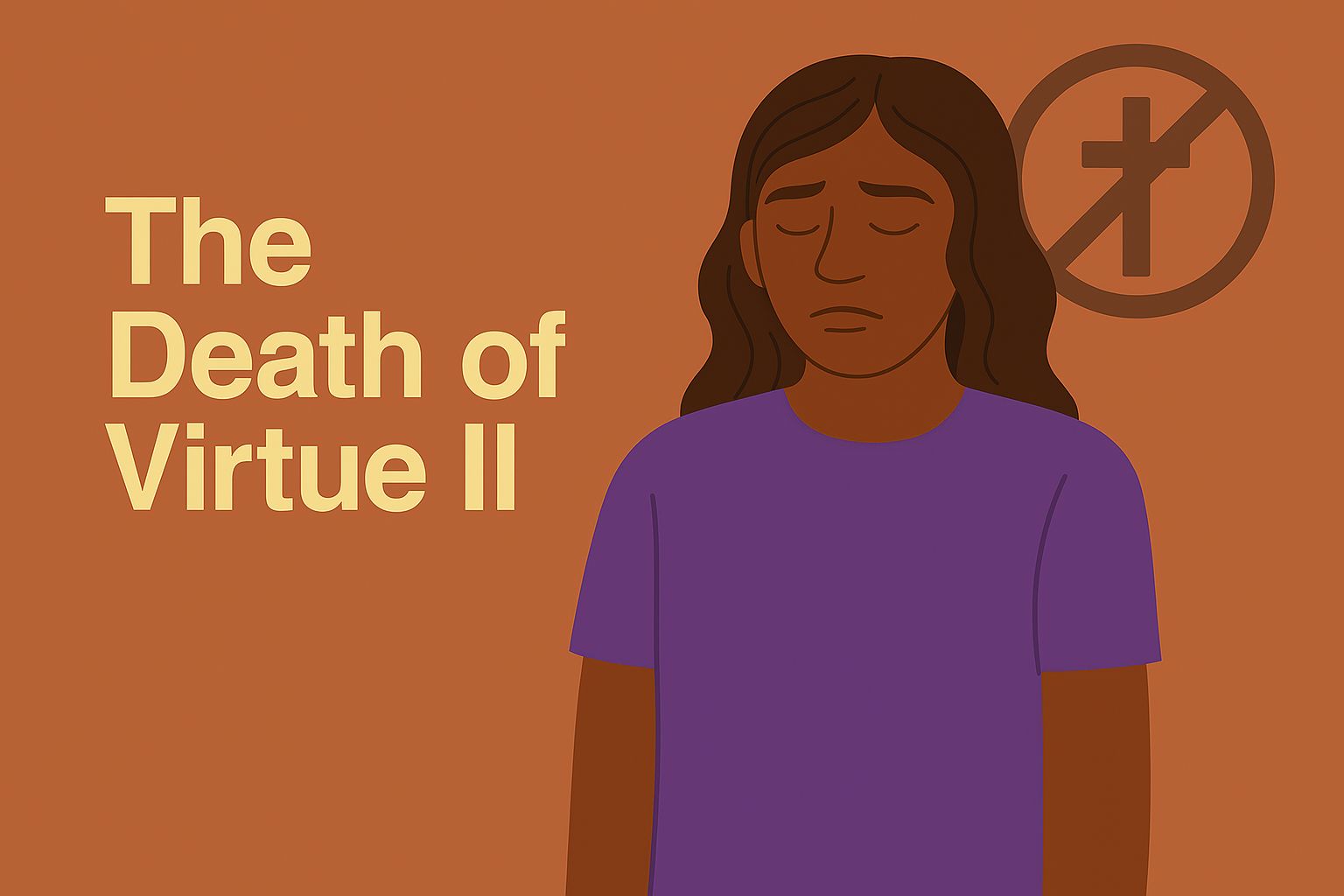
In the seventeenth-century, French author François de la Rochefoucauld wrote, The Death of Hypocrisy
“L’hypocrisie est un hommage que le vice rend à la vertu.”
Translation: “Hypocrisy is a tribute that vice pays to virtue.”
La Rochefoucauld recognized that in a virtuous society, however people behave, they still believe in transcendent virtues and in their importance to the individual and society. Even when people are guilty of vice, i.e., doing what they know to be wrong, they still wish to appear virtuous or morally upright. In such a society, hypocrisy is possible: people do not practice what they preach, but they still acknowledge the existence of a higher moral standard than that which they are practicing. In other words, they believe in virtue.
Blending the ideas of La Rochefoucauld and Kreeft, a conclusion presents itself:
The possibility of hypocrisy ceases to exist in society because the knowledge of virtue ceases to exist in people’s hearts and minds. When people no longer know what virtue is, hypocrisy can no longer exist; it has no basis.
For the first time in history, the possibility of hypocrisy apparently no longer exists; the knowledge of virtue has vanished in society. Yes, there are virtuous individuals and groups within society, but on the whole, the knowledge of virtue has ceased to exist in people’s hearts and minds. Because this is true, hypocrisy is no longer possible.
Sadder still, within this societal reality is found a second and more shocking reality: many Christians demonstrate this same absence of knowledge of virtue. Some even lack the desire to possess it.
THE MEANING OF MEANINGLESSNESS
Lack of knowledge is not an academic or merely philosophical dilemma. It is a principled and practical one. Even a deadly one.
“If a child’s moral growth does not keep pace with his physical growth, there may soon be no child. Could this explain why the most common age for suicide today is adolescence? The human race is now in its adolescence and standing on the edge of a cliff.”
Each year, a child’s family celebrates his birthday. As a part of the celebration ritual, family members applaud the child’s physical growth: “Look how big he is getting!” Mom and Dad beam in pride and joy.
But if there is not a concurrent moral development that keeps pace with physical development, in time, this growing boy will become a dysfunctional man: by appearances healthy; but in reality, unhealthy. Dangerously so. Review tonight’s evening news for the latest evidence of this phenomenon: Moral development is not keeping pace with its development in other areas.
God has formed every individual in His image. This includes creating each of us with a built-in belief in transcendent goodness. Proof? Every person, religious or not, can make a list of things he believes to be right or wrong, virtuous or evil. The individual items on people’s lists may differ, but every person’s list provides proof of a universal belief in transcendent goodness, i.e., virtue.
This is so because every person is born with a God-given need for a sense of virtue, societally and personally.
But when this need for virtue is not met, societies tip over and personal worlds spin out of control. As a child becomes an adult, his mind looks for answers to life’s transcendent questions: what is the meaning of life, is the universe good or evil, is there a God and is He good, what does God require of me? But when he finds no reliable answers, i.e., no absolutes to guide him, life ceases to have meaning for the individual, and so, he inches toward the edge of Kreeft’s cliff and its fall into emptiness. Life has no fixed points by which he can define his life or the world, and so, what in the world is there to live for?
The opposite of virtue is vice, but the absence of virtue is not vice; it is a void. It is an abyss of emptiness and desolation, a world – and life – devoid of meaning or purpose. And when void replaces virtue it is then that vice rushes in to fill the gap between meaninglessness and emptiness: eat drink and be merry, for tomorrow we die. Nothingness inevitably implodes, however sparkling the party down.
THE VOID IN REAL TIME
The absence of virtue and the presence of this void are evident globally today as emptiness and vice – death – wage war and threaten to rule our society.
Consider the evening news:
Meaninglessness (absurdism) now triumphs over transcendent meaning;
Public silencing and shaming – cancel culture – openly bare-knuckle science, free inquiry, and free speech;
Human deconstruction seeks to dethrone divine creation: destruction is called construction;
Victimhood is extolled over living heroically;
Gender is a seen as a construct and “binary” is the newest four-letter word;
Violence is the new peace, and revenge is the new justice;
Power has replaced truth as the ultimate currency;
The inevitability of dystopia has displaced dreams and dreaming;
Hopelessness has replaced hope – for today, tomorrow, and forever;
Truth is in the eye of the beholder and is always open to change – it is individual and of this moment only.
At the end of this path, death stands with its jackboot on the throat of all things pertaining to life. Heaven and hell stare in disbelief as an entire population lines the parade route to applaud its own suicide, the victim of its own felt emptiness, its own willful abandonment of virtue.
Kreeft writes that our generation is not morally weaker or more wicked than our ancestors: all generations and peoples have embraced their share of evil. But we are weaker in our knowledge of morality and goodness.
Our ancestors’ problem was that of not living up to their principles. Our problem is far more dangerous: we don’t have any principles at all; we have no objective moral standards.
Virtue lies dead or at least dying in the streets, townhalls, homes, and even in many churches. And God help the one who still dares to speak and write about them.
Therefore, as Kreeft writes, the fundamental problems for modern man are these:
- The absence of virtue;
- The absence of the knowledge of virtue (what it is);
- The absence of how to get back to virtue.
And how to satisfy the void that is violently gorging itself on our remains.
A FINAL THOUGHT
This absence of the knowledge of virtue has not come upon us unaware. We have willingly and doggedly pursued it – in education, media, the arts, politics, government, law, medicine, science, . . .
And even in segments of the church.
As study after study demonstrates, many churches no longer believe in transcendent truth and many Christians no longer believe in absolute right and wrong. They “believe in God” but they do not accept His revealed truth, preferring instead their own designer belief systems. Effectively, they are creating their own gods. Virtue is dead or at least dying; church “worship experiences” are often little more than post-modernist wakes.
With this abandonment of virtue comes the void. Christians in name, they find no meaning in their lives, and so, the unthinkable becomes inevitable among the people who bear the name of Christ: what were once vices are now virtues.
In two weeks, we’ll continue this post-mortem on virtue in examining the techniques we have invented in our vain attempt to satisfy the void. We’ll also look at the cost to individuals and to society as these techniques take hold and are given the official seal of approval. Finally, we will consider the only road back to the virtuous life and why Christians must once again find it and passionately – life and death passionately – embrace it.













Comments (0)
Facebook Comments (0)