
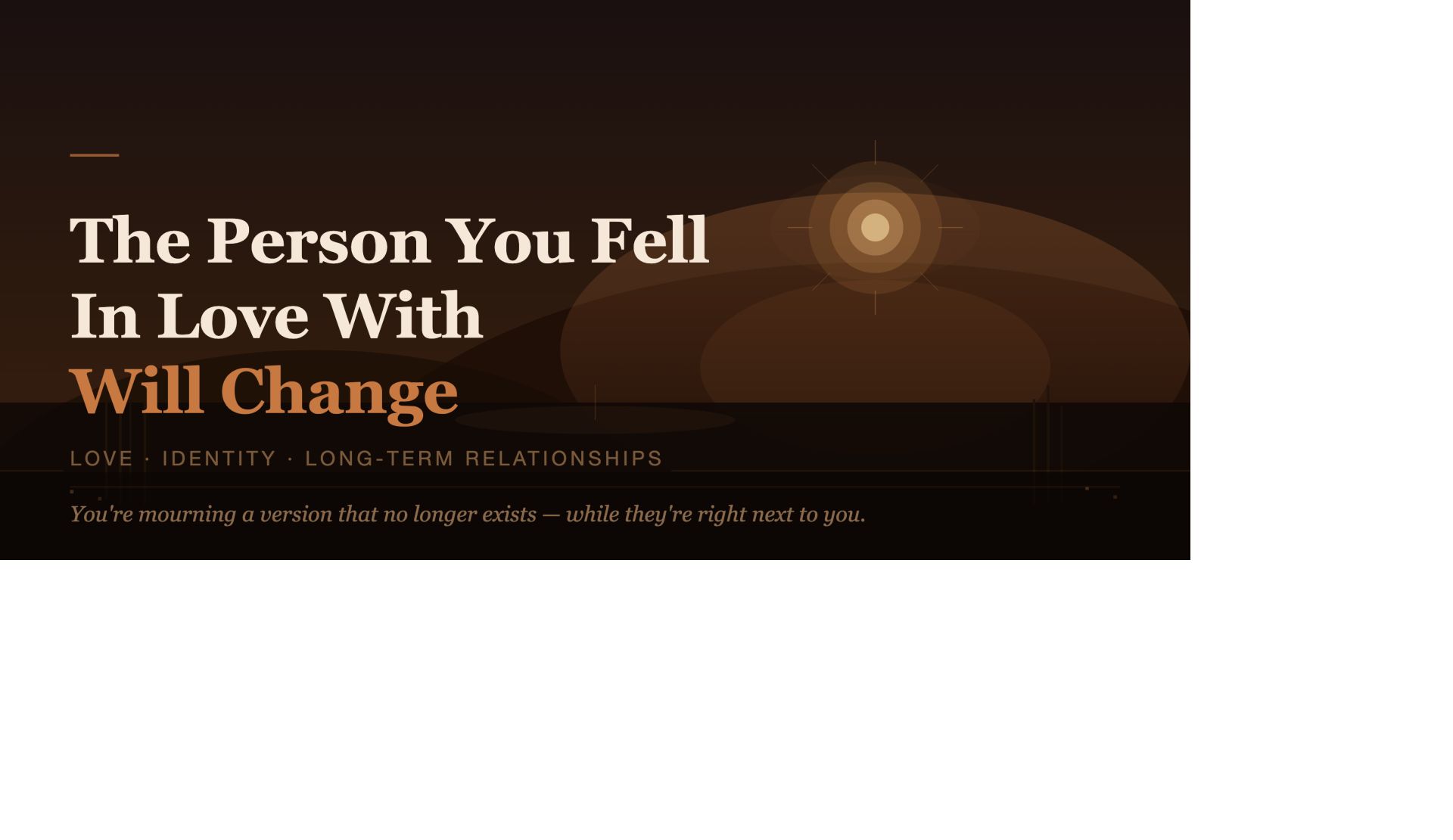
The Person You Fell In Love with With Change
 admin
Jun 22, 2026
230
0
admin
Jun 22, 2026
230
0
We usually fall in love with a snapshot.
You meet someone and build a mental portrait of their best moments: the way they laugh at your jokes, the conviction with which they said they’d never go corporate, their certainty about where they wanted to live.
You stay loyal to that first version and quietly resist every version that comes after.
The brain doesn’t experience a changed partner as growth; it experiences something being off. The way they used to react, the things they cared about, how conversations flowed—these things used to be automatic. Now you have to think about what to say, how they’ll take it, what they mean.
That effort feels like friction, and over time, friction starts to feel like incompatibility.
That’s why the change feels bigger than it actually is.
You lie in bed at night, watching them scroll, and you notice you’re not curious about what they’re looking at. That’s the tell. Not the silence: the absence of wanting to break it.
You’re not just resisting their change. You’re resisting the effort it takes to understand who they’ve become. You’re mourning a version of them that no longer exists, while the person they’ve become is right next to you.
Your Relationship Has an Expiration Date That Most Couples Miss
To truly “have and to hold” someone is to stay interested in who they’re becoming, even when who they’re becoming is inconvenient, unfamiliar, or nothing like who you fell for.
You don’t marry one person.
You stay with different versions of them, and the shift is gradual enough that you don’t notice until you’re already living with someone new.
What works between you doesn’t last as long as you think.
The way you were together at 29 isn’t how you are at 34.
The expectations you set back then about who handles what, how you argue, and what you need from each other’s, don’t carry over on their own.
If you don’t revisit them, they don’t disappear. They come back as the same tension you keep circling, and eventually, as resentments you can’t quite name.
Most couples don’t fall apart because of one big moment.
They drift because they’re still having conversations with the person they met, while living with someone who’s no longer that version.
Which raises an uncomfortable question: what do you do when you realize the relationship you’re in no longer fits who you both are?
That’s where the “pre-emptive burn” comes in.
It’s uncomfortable precisely because nothing has officially gone wrong yet. Most people wait for the house to catch fire before they discuss the wiring. They wait for the affair, or the months of bedroom silence. By then, you’re doing damage control.
The pre-emptive burn is the deliberate choice to say: “I don’t like the life we’ve built this year. I’m starting to resent the way we talk to each other, and I need us to dismantle this version of ‘us’ so we can build something better.”
It’s a conversation that starts before either of you has a specific complaint, which is exactly why most people never start it.
You’re choosing the sharp heat of a controlled burn over the slow, airless death of a relationship that has quietly run out of oxygen.
What It Actually Costs You When Your Partner Grows
To stay together long-term, you have to preside over the funerals of your partner's past selves.
What looks like growth from a distance feels, from inside the relationship, like losing ground you didn’t know you were standing on. The person who used to need your reassurance stops needing it. The person who deferred to your judgment starts pushing back.
From the outside, that’s evolution. From the inside, it can feel like replacement.
You cannot hold someone’s hand if your fist is clenched.
To “hold” someone in a healthy way is to remain open to who they currently are — not who they were when you made your promises. It means releasing the story of your relationship to make room for the truth of it.
Every time you catch yourself thinking “they used to be so...”, you’re grieving a version of them that’s already gone, and calling it disappointment.
The moment you think you fully know your partner is the moment the intimacy starts drying up.
Real intimacy is the commitment to remain curious about a person who keeps changing. Instead of finishing their sentences, let them hang in the air. Listen for the new vocabulary they’ve started using — words they didn’t reach for three years ago. The topics they suddenly care about. The opinions they’ve quietly stop holding onto too strongly. The things they no longer react to the way they once did.
These aren’t warning signs. They’re the person telling you who they’re becoming if you’re paying attention.
A real relationship asks you to grieve versions of your partner you once depended on.
It’s the silent car ride home after they spent the whole dinner talking about something you have no feeling for and realizing the silence between you isn’t awkward anymore. You’ve both stopped trying to fill it.
That silence doesn’t just feel like boredom. It feels like loss, and the worst part is you’re grieving someone who is still right there, and you can’t explain that to anyone without sounding like you’re asking for something unreasonable.
But the hardest part isn’t that they’ve changed. It’s the quieter fear underneath: they might no longer need the version of you that you’ve spent years perfecting.
If they become self-sufficient, your role as the fixer dies with it. If they outgrow the dynamic, you built together, the identity you built around them becomes unstable.
We often resist our partner’s growth not out of selfishness, but because we have a deep attachment to the role their limitations gave us. If they no longer need saving, what exactly have you been doing all these years? That question is easier not to ask.
Most of us act as architects, trying to shape our partners into something that suits our existing floor plan.
It’s the correction you make to their story at a dinner party because you want them to sound more like the person they used to be. You’re not correcting a fact. You’re defending a version of them that makes you feel more comfortable.
It’s the moment they say something new about themselves and your first instinct is to redirect it back into something recognizable.
Your job is to witness them, not edit them back into someone easier to recognize.
Match their pace. When they shift, adjust, instead of redirecting.
Sometimes it looks like nothing. They mention a new interest you don’t share, and instead of redirecting, you ask one question. Not because you’re suddenly fascinated but because they are.
That’s it. That’s the whole move. It’s smaller than people expect, and harder than it sounds.
The Difference Between a Relationship That Lasts and One That Just Continues
There’s a difference between a marriage that has lasted and a marriage that is alive.
What separates them is simpler and harder than people expect: one partner notices they’ve been working from an old version of the other, and updates. The other keeps responding to someone who is no longer quite there.
You stop treating new interests or shifting values as threats. You stop relitigating arguments that were never really about what they appeared to be — the one where you’re fighting about dishes but actually fighting because the person who used to handle them without being asked now believes their time is worth more than that.
The argument on the surface is never the argument underneath.
Contrast this with what happens when neither person updates.
It’s the 20-year marriage where both partners have stopped moving. It’s quiet. Predictable. Efficient. And slowly, it becomes lifeless. You stop telling them about your day because you already know exactly how they’ll respond. The anticipation that once made their reactions feel safe now makes them feel unnecessary.
Eventually, you stop speaking not because of conflict, but because nothing feels new enough to mention.
What You're Actually Signing Up For
You can never truly “have” another person. You can only witness them.
The relationships that last aren’t the ones where nothing changes. They’re the ones where the core — how they fight, whether they’re honest, whether they keep choosing each other — stays fixed while everything else moves around it.
Everything else — their ambitions, their needs from you, the way they want to be loved, who they are on a Tuesday night — is allowed to shift.
The moment most people miss isn’t the big drift. It’s the small deflection. The time they said something new about themselves and you changed the subject, because the old subject was easier. That’s the one worth catching.
Before you commit, or recommit, ask yourself: Am I willing to love the three or four people this person is going to become, even if I don’t like all of them?
That’s the question underneath the vow.
And sometimes the honest answer is no. Sometimes who they’re becoming is genuinely incompatible with who you are. But most people never get that far, because they stopped paying attention long before the question became unavoidable.
Most people, if they’re honest, don’t know. And that not-knowing is worth sitting with longer than the question usually gets.
Commitment is not a decision you make once. It’s the smaller decision you make every time the person in front of you is slightly different from the one you expected, and you stay curious instead of defensive.
You can’t hold them by keeping them still. You hold them by paying attention as they move, and accepting that some of what you see, you won’t like.
That’s the commitment.












Comments (0)
Facebook Comments (0)