
Time Is The Currency Of Life
 admin
Sep 5, 2026
129
0
admin
Sep 5, 2026
129
0
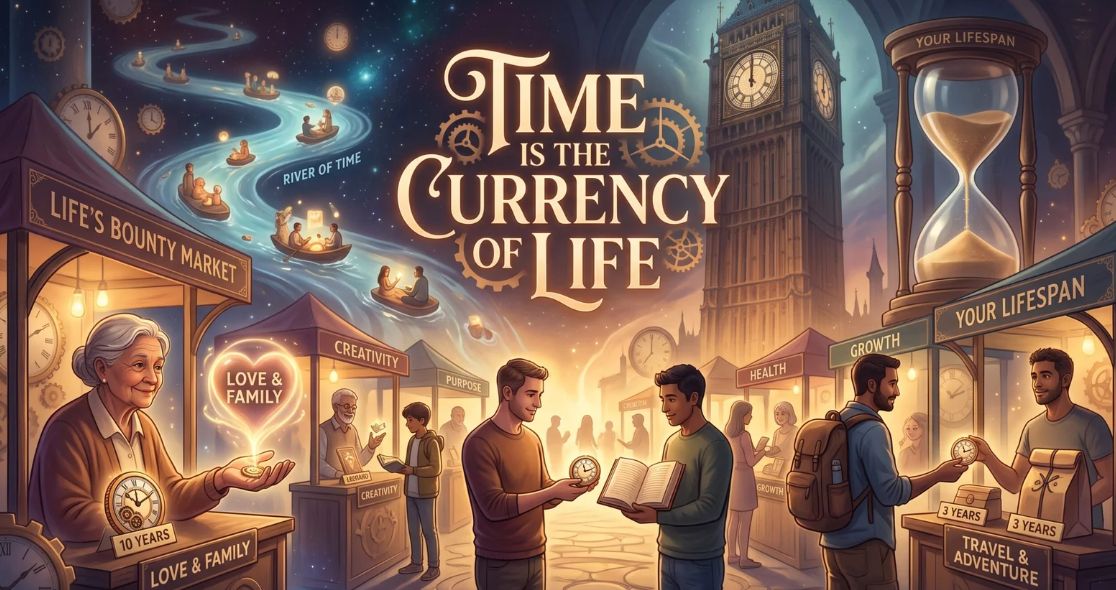
Money is not the currency of life.
Time is.
Think about it. If I had unlimited time, then I could make unlimited money. But we do not have unlimited time, so we are left to make decisions about what we will trade that time for.
Most of us have been making those trades without really thinking about them. We trade our hours for income. We trade our years for the idea that one day, somewhere down the track, we will finally be able to relax and enjoy what we have built.
But when you’re sitting in a room with an oncologist, you realise how much of your life has been aimed at a future that was never guaranteed. You realise how easily “one day” can disappear. And you start to wonder what exactly you have been building toward.
Don’t get me wrong. I’m not saying money does not matter. It does. It helps. It gives options. And we can’t exactly choose to put our feet up and do nothing in life, unless we plan on going hungry. Money is important.
But the one thing money cannot give you is more time.
I wish it could.
I really wish it could.
Long before money moguls and financial gurus were telling us how to get rich, Jesus was teaching his followers about money. In fact, it might surprise you to learn that Jesus spoke more about money than almost any other topic.
He spoke about money more than heaven. More than hell. More than faith. More than prayer. More than sin. More than love, at least in explicit, direct terms. More than most individual theological topics, we ended up building entire belief systems around.
Why?
Perhaps Jesus knew that the way we handle money reveals something about who we really are and what we truly value. And that is why one story in particular still resonates from the ancient Middle East to our modern day world.
Let’s take a look.
The Man Who Built Bigger Barns
In Luke 12, Jesus Christ tells a story about a wealthy landowner whose fields produced an unusually large harvest.
The man looked at everything he had and realised he did not have enough room to store it all. So he came up with a plan. He would tear down his existing barns and build bigger ones so he could store all his grain and goods.
With that sorted, he said to himself that he was set for years to come. He had more than enough. Now he could take it easy, eat, drink, and enjoy life.
But that very night, his life came to an end.
And the question lingered. What would happen to everything he had spent his life building? Jesus ends the story by saying this is what it looks like when someone stores up wealth for themselves but is not rich toward God.
The Hidden Meanings
The moral of this story seems pretty obvious, right?
Work too much, store up too much, focus too much on money, and you miss what really matters.
It reads like a warning against greed. A reminder not to get obsessed with building wealth. A nudge to be generous, maybe slow down a bit.
Fair enough.
But the story is a bit more uncomfortable than that, because the man does not do anything obviously wrong. He is not stealing. He is not exploiting anyone. He is not living some wild, reckless life. He is successful, organised, and planning ahead.
He sees a problem and solves it. He has more than enough produce and nowhere to put it, so he builds more storage. That is not foolish. That is what most of us would call wise.
In fact, if you took this story out of the Bible and dropped it into a finance podcast, the guy would probably be held up as an example of good stewardship. He is thinking long term. He is preparing for the future. He is creating security.
And yet, in the story, he is called a fool.
Which means the issue is not just what he did.
It is something deeper about how he was thinking.
Pay Attention to the Way He Thinks
If you slow down and listen to the way he talks, something starts to standout. At first, it sounds completely reasonable. His crops have done well. He has run out of storage. He is thinking through a plan like anyone would.
But then you notice the pattern.
Here it is in the NIV (Luke 12:17–19):
“He thought to himself, ‘What shall I do? I have no place to store my crops.’ Then he said, ‘This is what I’ll do. I will tear down my barns and build bigger ones, and there I will store my surplus grain. And I’ll say to myself, “You have plenty of grain laid up for many years. Take life easy; eat, drink and be merry.”’
Read it again slowly.
What do you notice?
It’s the singular personal pronoun “I”.
It is a conversation, but there is only one voice in it. Every line keeps circling back to himself. What shall I do? I have no place. This is what I will do. I will build. I will store. I will say to myself.
By the time you reach the end of it, you start to notice what is not there.
What This Story Is Inviting
It would be easy to turn this into a warning about greed and move on, but the story is not really pressing on greed. It is pressing on something far more ordinary, which is why it is harder to see.
Look at where the man locates the problem. He does not say that he has had a good year or pause to recognise what has happened. He immediately frames it as a storage issue and says, “I have nowhere to store my crops.” The abundance does not expand his thinking. It narrows it. What could have been received as a gift becomes something to manage, contain, and control.
Then notice how quickly he moves to certainty about the future. He says, “You have plenty of grain laid up for many years.” There is no sense of risk in that sentence and no awareness that time itself sits outside his control. He speaks as though the years ahead are already secured, as though what he has accumulated now can guarantee what comes next.
From there, everything follows logically. If the future is secure, then rest can be postponed until later. Enjoyment becomes something scheduled for a future moment, once enough has been built and stored. Life is something he believes he will finally enter into after the work of securing it is complete.
This is where the repetition of “I” starts to matter. It is not just a stylistic detail. It shows how self-contained his thinking has become. Every question begins with him, every solution ends with him, and the entire future is imagined as something he will step into on his own terms. There is no reference point beyond himself, no interruption to his assumptions, and no space for anything he cannot control.
That is the invitation of the story. It is not simply asking whether we have too much. It is asking whether we have built our lives on the same logic. It is asking whether we have quietly reduced what we have been given into something to manage, assumed that time will be there when we are ready for it, and pushed the experience of life further and further down the road.
One Last Thing Jesus Leaves Us With
There is one final line that Jesus Christ adds at the end of this story, and it pulls everything together. He says that this is what happens when someone spends their life storing things up for themselves but never becomes rich toward God.
What does that mean? To be rich toward God?
When I was a kid, I might have thought that meant putting money in the church offering plate each week, but that does not even scratch the surface.
In the story, the man is not criticised for having wealth. He is not corrected for planning ahead or for succeeding. The issue is that everything he has stays with him. His thinking, his decisions, and his sense of security all circle back to his own future. Nothing in his world reaches beyond that.
To be rich toward God means your life does not work like that.
It means what you have is not just about you. Your money, your time, your attention, and your energy are not all directed toward protecting your own comfort or securing your own future. There is a movement outward. There is an awareness that what you have is not only something you have built but also something you have received.
That changes how you live.
It changes how you spend. It changes how you give. It changes how you show up. It means you stop pushing the meaningful parts of your life into a future that may or may not arrive, and you begin to live them now, while they are still available to you.
Don’t wait for tomorrow.
Take it from me. Sitting in a hospital room has a way of making this painfully clear. The idea that you will get to it later loses its grip very quickly. The conversations you keep delaying matter now. The people you keep meaning to prioritise matter now. The things that actually carry weight do not belong in some distant version of your life.
Be wildly generous while you can. Be generous with your money, and just as importantly, be generous with your time and your presence. Say what needs to be said. Show up for the people who matter. Spend on the things that actually carry meaning.
And whatever you do, don’t assume that there will be time later to spill the contents of your barns and feast on life.
Today is the day.













Comments (0)
Facebook Comments (0)