
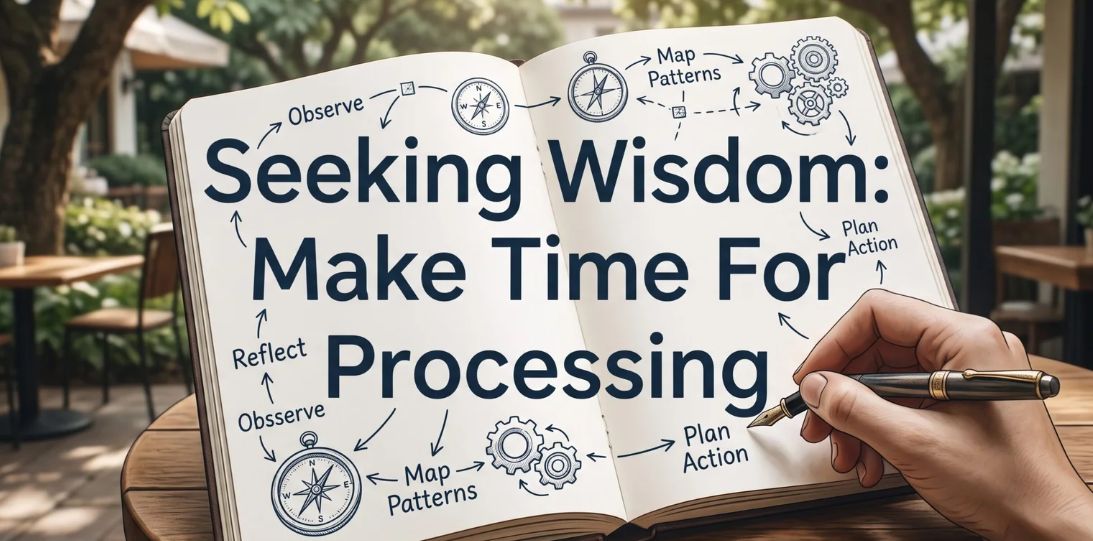
Seeking Wisdom: Make Time For Processing
 admin
Sep 4, 2026
112
0
admin
Sep 4, 2026
112
0
The young man was not a prodigy. In fact, he was ordinary by his own standards. His peers didn’t think he was that special. He worked as a patent clerk in Bern, a job far from academia. His professors had been unimpressed. His early career was a series of closed doors. This was Einstein in 1905. He didn’t have a university post. Or a team of researchers. He had a desk, a stack of patents, and his own mind. In that year, he published four papers that rewrote the laws of physics. He unlocked the photoelectric effect, explained Brownian motion, introduced special relativity, and gave us E=mc². That’s a lot of scientific terms. I won’t attempt to explain them. This essay is about how Einstein thought differently. And figured out things that changed the world.
Start by protecting your sacred flame.
When Albert Einstein was a child, his father gave him a compass. “Einstein had been only four or five years old when his father gave him that compass. It was one of those small tokens that somehow change the world. Watching the way an invisible force always guided the compass needle north had convinced Einstein that “something deeply hidden had to be behind things.” He spent the rest of his life trying to find it,” writes Amanda Gefter. Curiosity kept Einstein’s brain going for decades. More than anything, it’s what made him smart. Curiosity is what makes you willing to imagine an answer before you’re sure it’s correct and then test it, revise it, and imagine again. He famously wrote, “I have no special talents. I am only passionately curious.” Curiosity turns effort into play. You can’t force your brain to memorise facts to look smart.
It will resist.
But if you follow a question that haunts you, recall becomes effortless. You are not studying anymore; you are solving a personal mystery. The physicist Richard Feynman felt the same way when he said, “I was born not knowing and have had only a little time to change that here and there.” Einstein’s curiosity was not limited to physics. He read philosophy. Discussed literature. He thought about religion. He played music. He was also interested in politics, society and human behaviour. During his years in Bern, he regularly met with Conrad Habicht and Maurice Solovine. They formed an informal intellectual group jokingly called the “Olympia Academy". Their conversations covered physics, philosophy, literature and broader questions about the world. This is an underrated habit. Smart people connect ideas from different worlds.
Imagine your mind as a collection of rooms.
With doors to different sources of knowledge. Most people keep the doors closed. Einstein opened them. A philosophical idea might change how you understand time. A psychological principle might change how you understand human behaviour. This habit means you are not merely collecting information. But giving ideas opportunities to connect. The writer and philosopher Arthur Schopenhauer once said, “The task is not so much to see what no one has yet seen, but to think what nobody has yet thought about that which everybody sees.” That is close to the heart of Einstein’s approach. Look at ordinary things. Then question them. Don’t just collect answers. Collect questions. Keep a list of things you don’t understand, and treat that list like a clue to your next breakthrough. Specialised knowledge can become a trap.
Reading outside your field breaks that spell.
If you work in technology, read history.
If you work in finance, read psychology. If you write, read science. If you manage people, read biographies. If you want to understand yourself, read outside yourself. You are looking for mental cross-pollination. That’s how intellectual magic happens. “The important thing is not to stop questioning. Curiosity has its own reason for existence. One cannot help but be in awe when he contemplates the mysteries of eternity, of life, of the marvellous structure of reality. It is enough if one tries merely to comprehend a little of this mystery each day,” Einstein said.
And then set your imagination on fire.
It will take you places knowledge can’t.
“The true sign of intelligence is not knowledge but imagination.” Knowledge tells you what already exists and what’s already been done. Imagination reaches beyond that. It explores what could be. Einstein called imagination “more important than knowledge” because it has no bounds. It can help you see things that are not there. Einstein pictured a beam of light, rode alongside it in his mind, and figured out what that could mean in reality. His thought experiments were on steroids. And the imagination came long before he had the mathematics to formalise what he was seeing. The image came first. The equations came later, as translation. He used simple, concrete images to strip complex physics down to the simplest explanation possible. Imaginative brain work meant he stayed with problems longer in his head. The philosopher John Dewey argued that thinking begins not with facts but with a “felt difficulty", a nagging sense that something doesn’t add up, which imagination then works to resolve.
Einstein described his best ideas as arriving not as words or equations, but as feelings and images that came before language could catch up. “The words of the language, as they are written or spoken, do not seem to play any role in my mechanism of thought,” he wrote to the mathematician Jacques Hadamard. Only after the image had formed did he go looking for words and symbols to pin it down. You must tolerate the confusion between asking a hard question and finding a much better answer. Most people give up at the first sign of discomfort. If you train yourself to sit quietly with a problem for longer in your head, you are likely to connect dots that are not there.
That’s the imagination work.
Holding a single question in your mind and refusing to let it go until you’ve squeezed every possible answer out of it. That habit requires a lot of time alone. Einstein was not a social intellectual. He was a solo thinker. He needed silence. He needed to play his violin and let the subconscious work on the problem. He said, “The monotony and solitude of a quiet life stimulate the creative mind.” You cannot be smart in a crowd. You need time for your brain to wander, to connect unrelated dots, to sit with a problem without the pressure of an immediate answer. Schedule time to do nothing. Walk without staring at your phone.
Make time for processing.
It’s where the smart connections are made.
Einstein kept a violin in his study as a second thinking instrument. He said his discovery of relativity was, in some sense, “the result of musical perception.” When the equations stalled, he played. The problem would often resolve itself somewhere in the music, arriving back at his desk half-solved. Nietzsche made a version of this same argument about thinking and walking. “All truly great thoughts are conceived while walking,” he said. Einstein worked with a discipline that bordered on obsessive. He spent nearly a decade wrestling general relativity into its final form, filling notebooks with failed attempts. The imagination he held in high esteem was what gave the effort direction. Einstein worked on some of the most complicated problems in physics. But he approached them through simple mental pictures. A moving train. A falling person.
A beam of light.
A clock.
And an elevator. He did this because complexity can hide the practical problem. He wanted to get back to underlying problems. So don’t stop. Don’t stop questioning. Don’t stop imagining. Don’t stop staying with the problem long after everyone else has walked away. Einstein held onto these habits for decades. His entire life, if you ask me. He never broke the chain. Even when the questions grew impossibly complex. And the answers seemed to contradict everything the world believed. Intelligence is a practice. A daily, deliberate practice of looking at the world and refusing to accept it at face value. Einstein’s recommendation to you is simple. Be less certain and more curious. It makes you more alive.













Comments (0)
Facebook Comments (0)